unity 3d draw 2d line
Lines, trails, and billboards
Line Renderer component
Switch to Scripting
The Line Renderer component takes an array of 2 or more points in 3D space, and draws a straight line between each one. You can use a Line Renderer to depict anything from a elementary straight line to a complex spiral.
The line is ever continuous; if y'all demand to draw two or more completely separate lines, yous should use multiple GameObjects The fundamental object in Unity scenes, which can represent characters, props, scenery, cameras, waypoints, and more. A GameObject's functionality is divers by the Components attached to it. More info
See in Glossary , each with its own Line Renderer.
The Line Renderer does not render lines that accept a width in pixels The smallest unit in a computer image. Pixel size depends on your screen resolution. Pixel lighting is calculated at every screen pixel. More info
See in Glossary . Information technology renders polygons that take a width in world units. The Line Renderer uses the same algorithm for line rendering The process of drawing graphics to the screen (or to a return texture). Past default, the primary photographic camera in Unity renders its view to the screen. More than info
See in Glossary as the Trail RendererA visual effect that lets you to make trails behind GameObjects in the Scene as they motion. More info
See in Glossary .
Getting started
To create a Line Renderer:
- In the Unity card bar, go to GameObject > Furnishings > Line.
- Select the Line Renderer GameObject.
- Add together points to the Line Renderer's Positions array, either by directly setting array values in the Inspector A Unity window that displays information almost the currently selected GameObject, asset or project settings, allowing yous to inspect and edit the values. More info
Come across in Glossary window or by using the Create Points Scene Editing Mode. - Use the Inspector window to configure the color, width, and other brandish settings of the line.
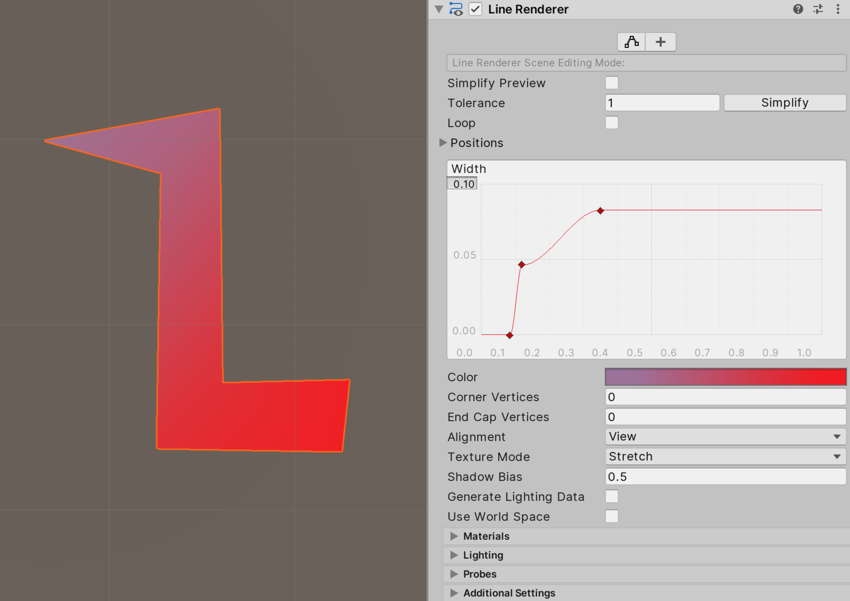
Line Renderer Materials
By default, a Line Renderer uses the congenital-in Material, Default-Line. You can brand many changes to the appearance of the line without changing this Material, such as editing the colour gradient or width of the line.
For other effects, such as applying a texture to the line, y'all will demand to use a different Textile. If yous do not want to write your ain Shader A program that runs on the GPU. More info
Come across in Glossary for the new Material, Unity's built-in Standard Particle Shaders piece of work well with Line Renderers.
Meet Creating and using Materials for more information.
Line Renderer Scene Editing Manner
You can utilise the Line Renderer's Inspector to modify the Scene A Scene contains the environments and menus of your game. Remember of each unique Scene file as a unique level. In each Scene, yous place your environments, obstacles, and decorations, essentially designing and building your game in pieces. More info
Come across in Glossary Editing Fashion. Different Scene Editing Modes enable y'all to use the Scene view An interactive view into the world y'all are creating. You use the Scene View to select and position scenery, characters, cameras, lights, and all other types of Game Object. More info
See in Glossary and the Inspector to edit the Line Renderer in dissimilar ways.
In that location are three Scene Editing Modes: None, Edit Points, and Create Points.
Setting the Scene Editing Fashion

Employ the Edit Points and Create Points buttons at the top of the Inspector to set the electric current Scene Editing Mode.
Click the Edit Points button to set the Scene Editing Mode to Edit Points. Click it again to set the Scene Editing Mode to None.
Click the Create Points push to fix the Scene Editing Mode to Create Points. Click it again to prepare the Scene Editing Mode to None.
Scene Editing Mode: None

When no Scene Editing Mode is selected, y'all tin configure and perform a simplification operation that removes unnecessary points from the Positions array.
The following controls are visible in the Inspector:
| Control | Description |
|---|---|
| Simplify Preview | Enable Simplify Preview to see a preview of the results of the simplification operation. |
| Tolerance | Fix the amount by which the simplified line can deviate from the original line. A value of 0 results in no deviation, and therefore little or no simplification. Higher positive values result in more than deviation from the original line, and therefore more simplification. The default value is i. |
| Simplify | Click Simplify to reduce the number of elements in the Line Renderer's Positions array. The simplification operation uses the Ramer-Douglas-Peucker algorithm to reduce the number of points, based on the Tolerance value. |
Scene Editing Mode: Edit Points

When the Scene Editing Mode is set to Edit Points, Unity represents each point in the Line Renderer'due south Positions array as a xanthous sphere in the Scene view. You can motility the individual points using the Movement tool.
The following controls are visible in the Inspector:
| Control | Description |
|---|---|
| Show Wireframe | When enabled, Unity draws a wireframe in the Scene view that visualizes the line. |
| Subdivide Selected | This button is enabled when you select ii or more than adjacent points. Pressing this button inserts a new indicate betwixt the selected adjacent points. |
Scene Editing Way: Create Points

When the Scene Editing Manner is ready to Create Points, you can click inside the Scene view to add new points to the end of the Line Renderer's Positions array.
The following controls are visible in the Inspector:
| Control | Description | |
|---|---|---|
| Input | Set up the input method you want to use to create points. | |
| Mouse position | Create points based on the mouse position in the Scene view. | |
| Physics Raycast | Create points based on a raycast into the Scene. Unity creates the point at the position where the raycast hits. | |
| Layer Mask A value defining which layers to include or exclude from an performance, such every bit rendering, collision or your ain code. More info See in Glossary | The layer mask to utilize when performing a raycast. This property is visible merely when Input is set to Physics Raycast. | |
| Min Vertex Altitude | When you drag the mouse to create points in the Scene view, the Line Renderer creates a new point when this altitude from the concluding bespeak is exceeded. | |
| Get-go | The offset practical to created points. When Input is fix to Mouse Position, Line Renderer applies the offset from the Scene camera A component which creates an prototype of a particular viewpoint in your scene. The output is either drawn to the screen or captured as a texture. More than info See in Glossary . When Input is ready to Physics Raycast, Line Renderer applies the start from the raycast normal. | |
Line Renderer Inspector reference

This department contains the following sub-sections:
- Line settings
- MaterialsAn asset that defines how a surface should be rendered. More info
Encounter in Glossary - Lighting
- Probes
- Additional Settings
Line settings
| Property | Function | |
|---|---|---|
| Loop | Enable this to connect the first and last positions of the line, and form a closed loop. | |
| Positions | The assortment of Vector3 points to connect. | |
| Width | Define a width value, and a curve value to command the width of your line along its length. The bend is sampled at each vertex, then its accuracy is limited by the number of vertices in your line. The overall width of the line is controlled by the width value. | |
| Color | Define a gradient to control the color of the line along its length. Unity samples colors from the Color gradient at each vertex. Between each vertex, Unity applies linear interpolation to colors. Adding more vertices to your line might give a closer approximation of a detailed gradient. | |
| Corner Vertices | This property dictates how many extra vertices are used when drawing corners in a line. Increment this value to make the line corners appear rounder. | |
| End Cap Vertices | This property dictates how many extra vertices are used to create finish caps on the line. Increase this value to make the line caps appear rounder. | |
| Alignment | Set up the direction that the line faces. | |
| View | The line faces the Camera. | |
| TransformZ | The line faces the Z centrality of its Transform component A Transform component determines the Position, Rotation, and Calibration of each object in the scene. Every GameObject has a Transform. More info See in Glossary . | |
| Texture Style | Control how the Texture is applied to the line. | |
| Stretch | Map the texture once forth the entire length of the line. | |
| Tile | Echo the texture along the line, based on its length in world units. To set the tiling rate, use Material.SetTextureScale. | |
| DistributePerSegment | Map the texture once along the entire length of the line, bold all vertices are evenly spaced. | |
| RepeatPerSegment | Repeat the texture forth the line, repeating at a charge per unit of in one case per line segment. To arrange the tiling rate, utilize Material.SetTextureScale. | |
| Shadow Bias | Gear up the amount to motility shadows away from the Light to remove shadowing artifacts cused by approximating a book with billboarded geometry. | |
| Generate Lighting Data | If enabled, Unity builds the line geometry with normals and tangents included. This allows it to utilize Materials that apply the Scene lighting. | |
| Use Globe Space | If enabled, the points are considered as earth space coordinates. If disabled, they are local to the transform of the GameObject to which this component is attached. | |
Materials
The Materials section lists all the materials that this component uses.
| Property | Description |
|---|---|
| Size | The number of elements in the material list. If you lot decrease the number of elements, Unity deletes the elements at the finish of the list. If you increase the number of elements, Unity adds new elements to the terminate of the list. Unity populates new elements with the same cloth that the element at the end of the list uses. |
| Chemical element | The materials in the list. You tin assign a material asset to each chemical element. Past default, Unity orders the list alphabetically based on the proper noun of the materials. This listing is reorderable, and Unity updates the number of the elements automatically as you lot change their order. |
Lighting
The Lighting department contains properties that relate to lighting.
| Property | Description | |
|---|---|---|
| Cast Shadows | Specify if and how this Renderer casts shadows when a suitable Light shines on information technology. This property corresponds to the Renderer.shadowCastingMode API. | |
| On | This Renderer casts a shadow when a shadow-casting Low-cal shines on it. | |
| Off | This Renderer does not bandage shadows. | |
| Two-sided | This Renderer casts two-sided shadows. This ways that single-sided objects like a plane or a quad can cast shadows, even if the light source is behind the mesh. For Baked Global Illumination or Enlighten Realtime Global Illumination to back up two-sided shadows, the material must support Double Sided Global Illumination. | |
| Shadows Only | This Renderer casts shadows, but the Renderer itself isn't visible. | |
| Receive Shadows | Specify if Unity displays shadows cast onto this Renderer. This property just has an effect if you enable Baked Global Illumination or Enlighten Realtime Global Illumination for this scene. This property corresponds to the Renderer.receiveShadows API. | |
| Contribute Global Illumination | Include this Renderer in global illumination calculations, which take place at bake time. This property but has an event if you enable Baked Global Illumination or Enlighten Realtime Global Illumination for this scene. Enabling this property enables the Contribute GI flag in the GameObject's Static Editor Flags. It corresponds to the StaticEditorFlags.ContributeGI API. | |
| Receive Global Illumination | Whether Unity provides global illumination data to this Renderer from baked lightmaps, or from runtime Low-cal Probes. This holding is only editable if you enable Contribute Global Illumination. Information technology only has an effect if you enable Baked Global Illumination or Enlighten Realtime Global Illumination for this scene. This property corresponds to the MeshRenderer.receiveGI API. | |
| Lightmaps | Unity provides global illumination data to this Renderer from lightmaps. | |
| Light Probes | Unity provides global illumination data to this Renderer from Low-cal ProbesLite probes store information about how light passes through space in your scene. A collection of light probes arranged inside a given infinite can amend lighting on moving objects and static LOD scenery within that space. More than info See in Glossary in the scene. | |
| Prioritize Illumination | Enable this belongings to ever include this Renderer in Enlighten Realtime Global Illumination calculations. This ensures that the Renderer is afflicted by distant emissives, even those which are normally excluded from Global Illumination calculations for operation reasons. This property is visible only if Contribute GI is enabled in the GameObject's Static Editor Flags, your project uses the Built-in Return Pipeline, and Enlighten Realtime Global Illumination is enabled in your scene. | |
Probes
The Probes section contains properties relating to Light Probe and Reflection ProbesA rendering component that captures a spherical view of its surroundings in all directions, rather like a camera. The captured epitome is and so stored as a Cubemap that tin can exist used by objects with reflective materials. More info
See in Glossary .
| Property | Description | |
|---|---|---|
| Lite Probes | Set how this Renderer receives light from the Light Probes system. This holding corresponds to the Renderer.lightProbeUsage API. | |
| Off | The Renderer doesn't use any interpolated Light Probes. | |
| Blend Probes | The Renderer uses one interpolated Calorie-free Probe. This is the default value. | |
| Use Proxy Volume | The Renderer uses a 3D filigree of interpolated Light Probes. | |
| Custom Provided | The Renderer extracts Light Probe shader compatible values from the MaterialPropertyBlock. | |
| Proxy Volume Override | Set a reference to some other GameObject that has a Light Probe Proxy Volume component. This property is only visible when Light Probes is set to Use Proxy Volume. | |
| Reflection Probes | Set how the Renderer receives reflections from the Reflection Probe system. This property corresponds to the Renderer.probeAnchor API. | |
| Off | Disables Reflection Probes. Unity uses a skybox for reflection. | |
| Blend Probes | Enables Reflection Probes. Blending occurs only betwixt Reflection Probes. This is useful in indoor environments where the graphic symbol may transition between areas with unlike lighting settings. | |
| Blend Probes and Skybox | Enables Reflection Probes. Blending occurs between Reflection Probes, or between Reflection Probes and the default reflection. This is useful for outdoor environments. | |
| Uncomplicated | Enables Reflection Probes, simply no blending occurs between Reflection Probes when there are ii overlapping volumes. | |
| Anchor Override | Prepare the Transform that Unity uses to determine the interpolation position when using the Lite Probe or Reflection Probe systems. By default, this is the centre of the bounding box of the Renderer's geometry. This property corresponds to the Renderer.probeAnchor API. | |
Additional Settings
The Boosted Settings section contains additional properties.
| Belongings | Description | |
|---|---|---|
| Movement Vectors | Set whether to apply move vectors to track this Renderer'southward per-pixel, screen-space motion from ane frame to the adjacent. You tin can employ this data to apply post-processing effects such every bit motion mistiness. Note: not all platforms back up motion vectors. Encounter SystemInfo.supportsMotionVectors for more information. This property corresponds to the Renderer.motionVectorGenerationMode API. | |
| Camera Motion Just | Use merely Camera movement to rails motion. | |
| Per Object Move | Utilize a specific pass to track motion for this Renderer. | |
| Force No Motion | Do not runway motion. | |
| Dynamic Occlusion | When Dynamic Apoplexy is enabled, Unity's occlusion cullingA feature that disables rendering of objects when they are not currently seen by the photographic camera because they are obscured (occluded) by other objects. More info See in Glossary organisation culls this Renderer when it is blocked from a Photographic camera's view by a Static Occluder. Otherwise, the system does not cull this Renderer when information technology is blocked from a Camera's view by a Static Occluder. Dynamic Apoplexy is enabled by default. Disable it for effects such as cartoon the outline of a character behind a wall. | |
| Sorting Layer | The name of this Renderer's Sorting Layer. | |
| Lodge in Layer | This Renderer'south order inside a Sorting Layer. | |
Lines, trails, and billboards
Source: https://docs.unity3d.com/Manual/class-LineRenderer.html
0 Response to "unity 3d draw 2d line"
Post a Comment